
Display Cabinets for Corners & Awkward Spaces: How to Use Every Inch
The dead corner, the narrow return wall, the gap beside a doorway.
Almost every retail floor, showroom and reception area has them — spaces too small for a standard cabinet but too visible to ignore. They quietly cost you: sitting empty, collecting clutter, or filled with a unit that doesn't fit. The fix isn't cramming a rectangular cabinet into a triangular space — it's choosing display built for the geometry you actually have.
Why corners are worth claiming
A corner is the one spot in a room visible from two directions at once. Walk into most retail spaces and your eye lands on the corners first — they frame the room and draw sightlines. Leaving them empty wastes your highest-visibility real estate. A purpose-built corner cabinet turns that liability into a feature: it fills the angle cleanly, holds product at eye level, and pulls foot traffic toward the back of the space instead of letting it stall at the entrance.
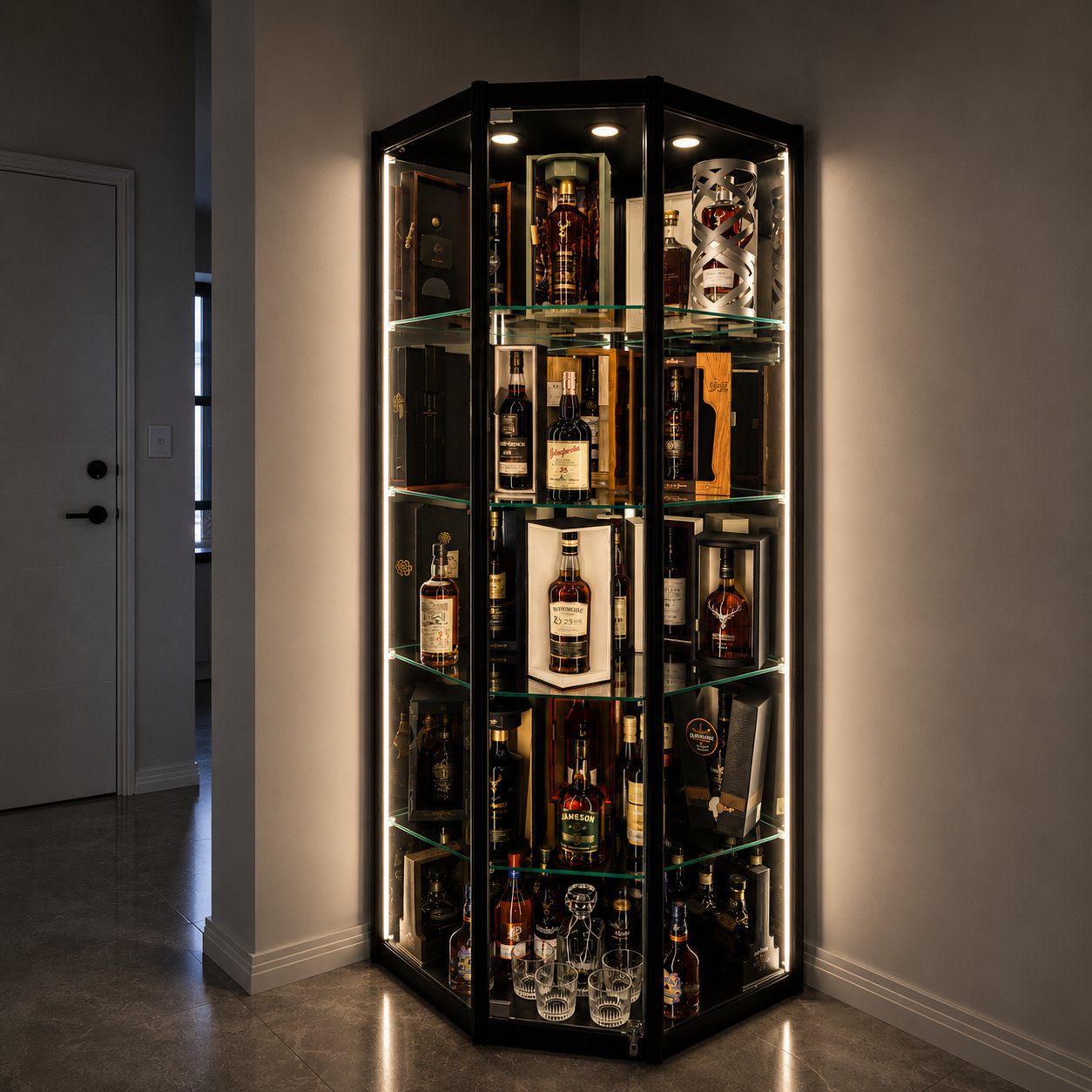
A LuxArc™ corner cabinet turning a dead angle into the focal point — Noranda, Perth.
Matching the cabinet to the space
Measure honestly before you choose. A true 90-degree corner suits a dedicated corner unit that sits flush into the angle. A narrow return wall — the short stretch beside a door or window — is better served by a slim tower that goes up rather than out. For an alcove or recess, a cabinet sized to the opening looks intentional rather than wedged. The mistake is forcing a standard rectangular footprint where the room is telling you something different.
What to look for in a corner unit
A good corner cabinet keeps every advantage of a standard one. A mirror back doubles the visible product and bounces light into what is usually a darker part of the room. Even, dot-free LED lighting matters more here than anywhere, because corners catch the least natural light. Lockable sliding doors keep stock secure without swinging into the walkway. And ultra-clear, low-iron glass means the product reads true from both viewing angles — no green tint distorting what the customer sees as they approach from either side.
Where corner cabinets work hardest
They suit collectors displaying a prized piece where two walls meet, retailers anchoring the rear of a shop, and reception or foyer spaces where a corner needs to feel finished rather than forgotten. The recent LuxArc™ install for a whisky collector in Noranda is a good example — a corner cabinet with a mirror back and lighting that made a previously dead angle the focal point of the room. The same logic applies to a jewellery counter, a trophy display, or a product showcase in any space where the geometry isn't a clean rectangle.
The LuxArc™ corner unit, installed and lit — Noranda, Perth.
• True 90-degree corner → dedicated flush corner unit
• Narrow return wall → slim tower, build up not out
• Alcove or recess → cabinet sized to the opening
If you've got an angle or alcove that's never quite worked, send us the measurements and we'll tell you honestly what fits.
Got an awkward corner? We'll make it work.
Send us the measurements and we'll tell you honestly what fits — supplied, delivered and installed across Perth and Australia-wide.