
The Hidden Cost of Cheap Display Cabinets: Why Buying Twice Costs More
A cheap display cabinet looks like a win on the day you buy it.
The price is low, it arrives, it holds stock. Six months later the doors stop sliding true, the LED strip flickers out on one side, and a shelf bows under weight it was never rated to carry. The saving you banked up front quietly becomes a cost you pay again and again — in repairs, in lost presentation, and eventually in replacing the whole unit. That's the hidden cost of cheap display cabinets, and it's almost always larger than the gap in the sticker price.
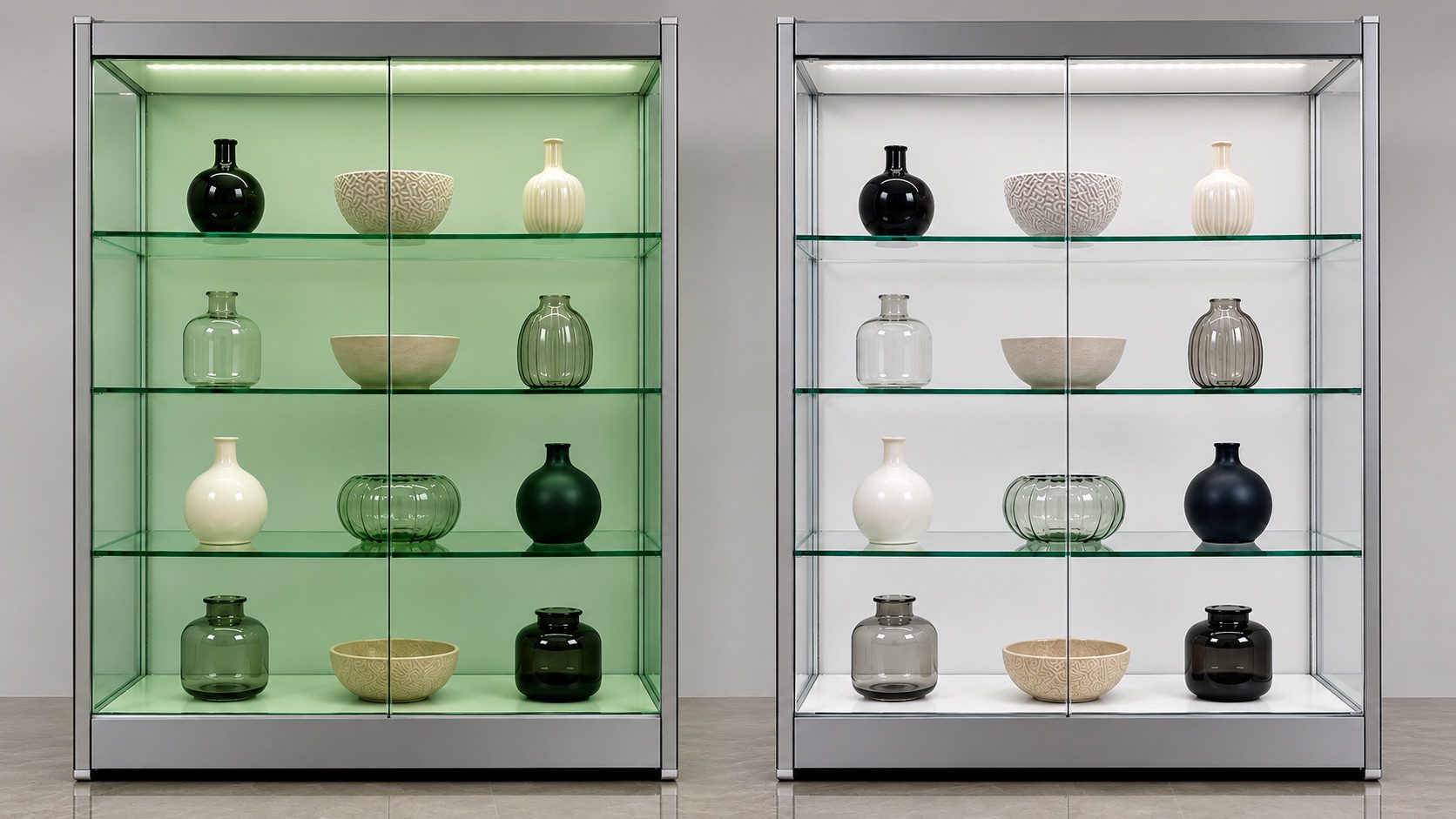
The difference is in the glass — a green cast dulls everything on the left; ultra-clear low-iron glass shows stock in its true colour on the right.
Where the price gets cut
A cabinet sold well below market isn't cheaper by magic — something has been removed to hit that number, and the cuts you can't see in a photo are the ones that bite. Thin high-iron float glass replaces ultra-low-iron tempered glass, so you get a heavy green wash across the whole panel face that dulls everything behind it — and cheap glass shatters into dangerous shards instead of safe granules. Shelf glass drops from 8 mm to 5 mm or thinner, halving the safe load. Frames switch from properly finished alloy to raw or lightly coated metal that marks and corrodes. Lighting becomes a generic strip with no driver protection, no app control, and a lifespan measured in months. None of it shows in a listing — it shows up in your store, in front of customers.
The repair-and-replace cycle
The real expense isn't the first failure — it's the pattern. A cheap cabinet rarely fails once: the lock seizes, then a door comes off its track, then the lighting dies, then a shelf cracks. Each fault is a call-out, a part you may not be able to source, and a cabinet sitting half-empty on your floor while you wait. Because budget cabinets are built from non-standard parts, replacements often don't exist — so a single broken shelf or hinge can write off the whole unit. You buy twice, sometimes three times, inside the window a commercial cabinet should have lasted untouched.
A commercial-grade cabinet bought once outlasts three cheap ones bought to replace each other — and costs less across its life.
What it does to your stock and your brand
A display cabinet has one job beyond holding product: making that product look worth the price. A green cast across the glass, a flickering strip, a shelf that sags in the middle — these don't just look cheap, they make your stock look cheap. Customers read the cabinet as a signal of how you run the business. Premium stock in a budget cabinet undersells itself every hour it's on display. The cost here never appears on an invoice, but it's real: lower perceived value, weaker conversion, and a showroom quietly working against you.
The commercial-grade alternative
A properly specified cabinet is built to commercial standards from the start: ultra-low-iron tempered glass for true clarity, 8 mm tempered shelves, sliding glass doors on a captured track, and integrated lighting with Bluetooth app control as standard. Parts are held for current and recent ranges, so a knock or a worn component is a quick fix, not a write-off. It costs more on day one — and less across every year after. That's the whole equation: cheap cabinets are expensive, and commercial cabinets are the saving.
Ask the seller four things: Is the glass low-iron and tempered? Are shelves 8 mm and load-rated? Are spare parts held for the range? What does the lighting driver and control system actually do? If the answers are vague, you're paying twice.
Do it once. Do it right.
Weighing a budget cabinet against doing it properly? Talk to us first — we'll tell you honestly which range fits your stock and your floor. Supplied, delivered and installed across Perth and Australia-wide.