
Why mirror-back display cabinets sell more than standard glass (and when they don't)
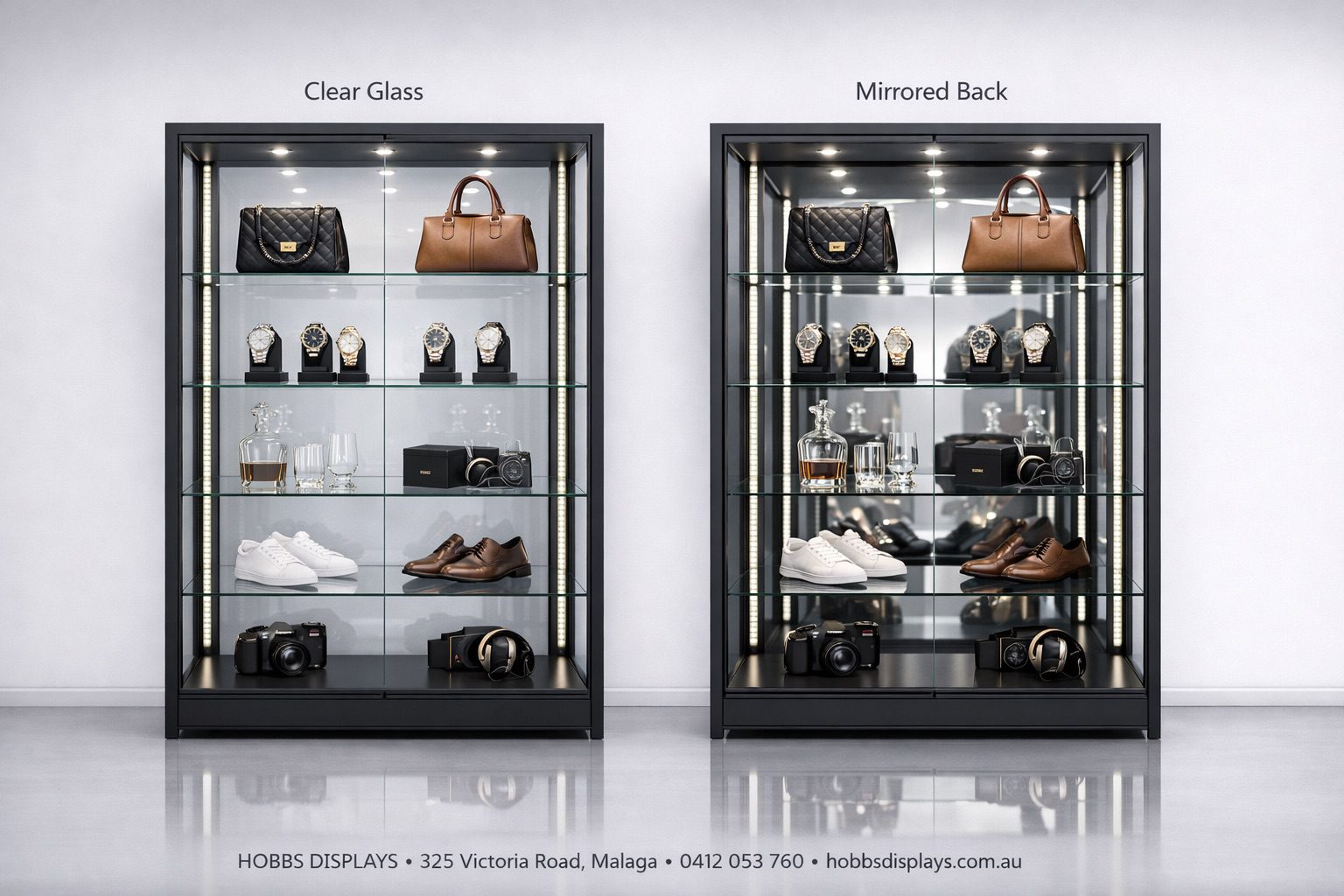
Let's be direct: a mirror back is not just a feature. It changes how products are perceived — three items start to look like six, and a half-filled shelf reads as intentional. But it is not right for every situation. Here is the breakdown.
Depth multiplies perceived stock
A tempered mirror back reflects your products, creating the illusion of more volume and density. Three items suddenly look like six; a half-filled shelf looks deliberate. In retail that matters — perceived abundance increases buyer confidence. That is not theory, it is human psychology.
Lighting works harder
With integrated LED lighting — especially vertical COB strips — a mirror back bounces light forward instead of absorbing it. You get brighter presentation, fewer shadows, cleaner contrast and a more premium feel. It is why our mirror cabinets read as high-end before a customer has even looked at the price. Light sells; darkness hides.
Premium means higher perceived value
A mirror back immediately signals that this is not a budget cabinet. Collectors notice it, retailers notice it, customers notice it. When you are displaying watches, jewellery, electronics, trophies or collectibles, presentation directly influences pricing power — you cannot charge premium prices with budget presentation.
When a mirror back is not ideal
Mirror is powerful, but not always correct. It may not suit back-of-house storage, industrial environments, spaces with heavy natural glare, or situations where wiring has to be hidden behind the unit. In those cases a clear-back or solid-back configuration is often more practical. Choosing the right cabinet is strategy, not emotion.
Mirror back vs clear or solid
| Consideration | Mirror back | Clear / solid back |
|---|---|---|
| Perceived volume | Reflects stock — shelves look fuller | Honest, one-to-one view of what's there |
| Lighting | Bounces LED light forward, brighter | Even light, no double reflections |
| Feel | Premium, high-end | Clean and neutral |
| Best for | Retail, jewellery, collectibles, feature displays | Storage, industrial, glare-prone rooms, rear wiring |
From 2026: tempered mirror glass as standard
From 2026, every Hobbs mirror-back cabinet ships with tempered mirror glass as standard — no thin, non-tempered panels. That means stronger structural integrity, safer handling and transport, a cleaner and more consistent reflection, and less risk during installation, all built for Australia-wide freight.
If you are investing in a proper display, the back panel should match the strength of the frame and shelving — not be the weak point. We do not claim to be the best in the market, but we do upgrade materials and specifications wherever it actually makes a difference.
Mirror multiplies perceived stock → shelves look fuller.
Mirror bounces LED light forward → brighter, fewer shadows.
Mirror signals premium → supports higher pricing power.
Skip mirror for storage, glare-prone or rear-wired setups.
From 2026, every Hobbs mirror back is tempered as standard.
The bottom line
Presentation affects sales, structure affects longevity, and lighting affects perception. A mirror back is one of the most effective ways to lift all three — but only where the setting suits it. If you are serious about what you are displaying, choose accordingly.
Tell us what you are displaying and where it will sit — we will advise the back, lighting and shelving that suit it, and build it to measure.
Shop glass display cabinets Back to guides